
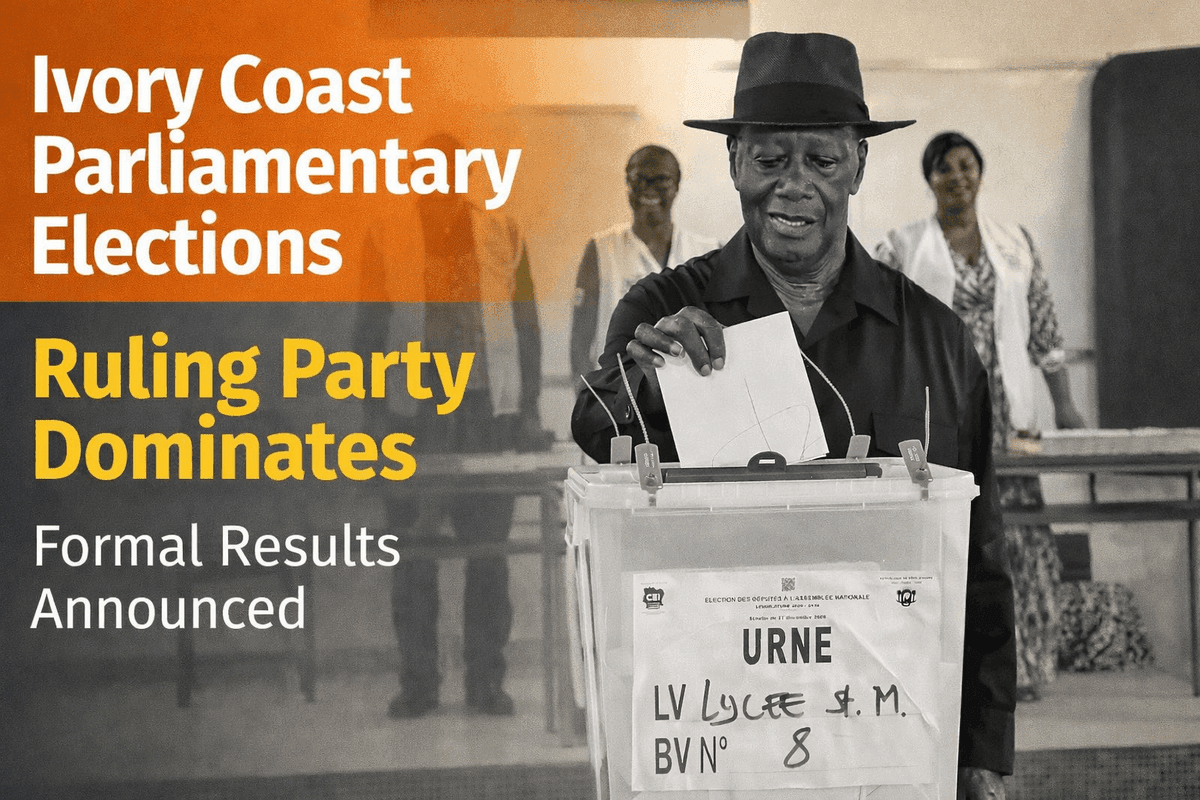
Ivory Coast’s political landscape has tilted further in favor of President Alassane Ouattara following parliamentary elections that delivered a decisive victory to the ruling party, reinforcing its dominance across both the executive and legislative arms of government.
Parliamentary elections results released by the country’s electoral authorities show that the Rally of Houphouëtists for Democracy and Peace (RHDP) secured a clear majority in the National Assembly, winning nearly four-fifths of the available seats. The outcome gives the government broad room to advance its economic and institutional agenda with limited parliamentary resistance.
The main opposition force, the Democratic Party of Ivory Coast–African Democratic Rally (PDCI-RDA), finished a distant second with a modest number of seats. The party is currently led by Tidjane Thiam, a former international banking executive, whose leadership has drawn attention to efforts to reposition the opposition ahead of future elections.
Former president Laurent Gbagbo’s political movement was notably absent from the vote. The party chose to boycott the elections, citing concerns over the credibility of the electoral process and dissatisfaction with the composition of the electoral commission. Its absence further reduced competition in the race and contributed to the ruling party’s dominant showing.
President Alassane Ouattara, now in his eighties, recently secured another presidential mandate in elections held in October, after several prominent challengers were disqualified from contesting. If he completes his current term, his time in office will span nearly two decades, making him one of the longest-serving leaders in the country’s post-independence history.
Ouattara first assumed power in 2011, in the aftermath of a violent political crisis that followed a disputed election. Since then, his administration has emphasized economic stability, infrastructure development, and efforts to position Ivory Coast as a regional investment hub. The country remains the world’s largest producer of cocoa, a sector that continues to play a central role in its economy.
Looking ahead, the government has outlined a multi-year development plan aimed at lifting Ivory Coast into the upper-middle-income category by the end of the decade. Key targets include accelerating economic growth, strengthening public institutions, reforming the judicial system, and improving access to public services. Authorities say these reforms are intended to support inclusive growth and attract both local and foreign investment.
Despite the decisive outcome, voter participation remained relatively low. Turnout figures from the parliamentary election fell well below those recorded during the recent presidential vote, raising ongoing questions about political engagement and public trust in the electoral process.
As Ivory Coast moves into the next phase of governance under a strengthened ruling coalition, the challenge will be balancing political dominance with inclusivity, accountability, and sustained economic progress—issues that remain central to democratic consolidation across the continent.