
From Zimbabwe to Australia, Charmaine Nyathi is turning her search for cultural identity into a literary movement celebrating African stories, creativity, heritage and, above all, Black joy.
For Charmaine Nyathi, a Zimbabwean-born Australian writer and founder of The Black African Family, that search became the foundation of an ambitious creative journey. What began as a personal desire to reconnect with her African roots has grown into a literary project with a much bigger purpose: bringing Africans and the diaspora closer to their heritage through stories that celebrate the beauty, diversity and everyday experiences of Black African people.
Born in Zimbabwe, Charmaine moved to Australia with her family as a child in search of a better life. However, growing up away from her birthplace came with an unexpected challenge: gradually losing touch with the culture and history that shaped her beginnings. Rather than allowing that distance to define her relationship with Africa, Charmaine decided to do something about it.

She began searching for her people, their stories, their histories and the remarkable things Africans are achieving around the world. In the process, she discovered an opportunity to create something that could help others experiencing the same sense of cultural distance.
That idea became The Black African Family.
Table of Contents
Turning Cultural Loneliness into a Celebration of African Identity
Charmaine’s journey into writing started long before the publication became a reality. She remembers loving writing while she was still in school, although pursuing a creative career was not something her household particularly encouraged.
For a long time, she never imagined that writing could become a sustainable profession.
“Honestly, I still don’t know if it is, but I’m going to try anyway. This is what I love, and this is what I’m good at,” she explains.
Her decision to establish The Black African Family was driven by a desire to reconnect with a part of herself that had gradually become distant.
But she wanted to approach that journey differently.
African stories are frequently discussed through the lens of colonialism, discrimination, conflict, poverty and historical injustice. While these experiences are important and deserve attention, Charmaine believes they represent only part of a much bigger story.
Africa is also a continent of extraordinary creativity, literature, music, architecture, craftsmanship, traditions, families and everyday pleasures.
She wants to explore those dimensions.
Rather than creating another publication centred primarily on the difficulties Africans have experienced, Charmaine is building a space where readers can discover something beautiful about African people and cultures.
“It’s a bit of a cliché, but I couldn’t find quite what I was looking for, so I’m making it,” she says.
It is a simple philosophy, but one that sits at the heart of her vision.
The Black African Family: A Literary Publication Celebrating Black Joy
At a time when digital media moves quickly and attention is often drawn towards controversy and negative headlines, The Black African Family is being built around a different editorial philosophy: delight.
For Charmaine, the decision to focus on positive African stories is not about ignoring the realities of history or pretending that challenges do not exist.
It is also a deliberate act of self-preservation.
She recognizes that spending years researching and writing about Black African history could become emotionally exhausting if the publication focused exclusively on suffering.
Instead, she wants to devote her time to discovering and sharing the things that make African cultures remarkable.
From African literature and traditional craftsmanship to music, art, architecture, family traditions and everyday experiences, the publication hopes to create an extensive collection of stories that readers can enjoy and learn from.
Charmaine believes there is room for a publication where Africans can come together, read about themselves and leave feeling happy.
“I want somewhere we can come to learn about our people, celebrate what we discover and simply enjoy being part of this enormous, wonderful family,” she says.
That is the distinctive vision behind The Black African Family: a literary home where African identity is explored through curiosity, appreciation and joy.
Why The Black African Family Chooses Words Over Pictures
One of the most interesting aspects of The Black African Family is its decision to operate as a text-only publication.
In an increasingly visual digital environment, where photographs, videos and graphics dominate online storytelling, Charmaine has deliberately chosen to focus on the written word.
For her, this is a personal creative decision and an opportunity to master her craft.
She wants her writing to combine the depth of academic research with the imaginative power of literature.
She describes the experience of reading something so beautifully written that the reader can almost taste the food being described, picture distant landscapes and feel as though the people in the story are sitting across the table.
That is the experience she wants to create.
“I see writing, words themselves, as my chosen craft. So I’m deliberately putting myself in a box to see just how good I can become at this one thing,” she explains.
Rather than relying on images to communicate an experience, she wants readers to see, feel and imagine through words alone.
It is an ambitious creative challenge, particularly in an era when online publishers are constantly competing for visual attention.
But it also reflects her commitment to literature as an art form.
Building a Global African Community Before Launch
Although The Black African Family is preparing for its January 2027 launch, the publication has already attracted considerable international interest.
Before its first issue was published, it had gathered more than 175 subscribers from different parts of the world, including 50 from Nigeria.
Its early readership spans countries such as Australia, Zimbabwe, Nigeria, Ghana, Kenya, South Africa, Botswana, Cameroon, the United Kingdom, the United States, Canada and several others.
For Charmaine, the response has been both surprising and encouraging.
She initially imagined that the publication would appeal almost exclusively to members of the Black African community. However, the growing subscriber base has revealed that people outside the community are also interested in discovering African cultures and stories.
This has expanded her understanding of the publication’s potential audience.
The Black African Family is not simply about Africans reconnecting with one another. It is also about creating opportunities for people around the world to appreciate the richness and diversity of African experiences.
For Charmaine, one of the most important things readers should take away is an understanding of the value of Black joy.
She believes African happiness, creativity and cultural expression deserve to be celebrated in their own right.
And that celebration should not be limited to particular occasions or historical milestones.
100 Books by 100 Black African Authors in 100 Days
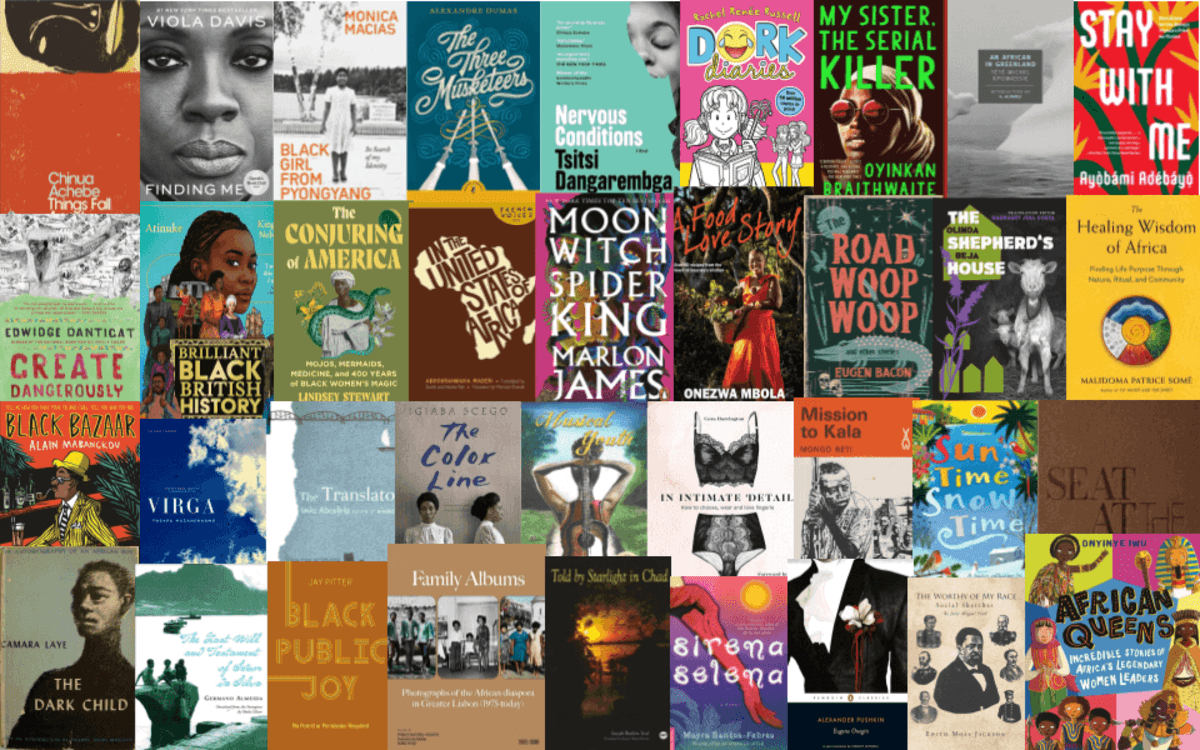
Even before the publication officially launches, Charmaine has begun putting her vision into action through an initiative titled 100 Books by 100 Black African Authors in 100 Days.
The project celebrates African literary talent by introducing readers to 100 books written by 100 Black African authors.
The initiative reflects one of her central ambitions: demonstrating the diversity of the African literary experience.
Through books, readers can explore different African countries, languages, generations, genres and perspectives.
Importantly, Charmaine wanted the selection to reflect the publication’s commitment to celebrating delight.
She acknowledges that stories of pain and suffering are important, but she also wants readers to discover African books that explore other dimensions of life.
The reading list includes works from different periods, genres and linguistic backgrounds, with English-language editions featured where available.
Her hope is that someone might discover the list months or even years later and find a new reason to explore African literature.
For aspiring readers, it offers an opportunity to discover authors they may never have encountered.
For African writers, it provides another platform for visibility and recognition.
And for the wider literary community, it reinforces an important message: African literature is far too diverse to be defined by a single narrative.
The Challenges of Building an Independent African Publication
Behind the inspiring vision is the demanding reality of building a sustainable independent publication.
Charmaine admits that she initially assumed being a writer would primarily involve writing.
The experience has taught her otherwise.
“Turns out, being a writer means being a writer about 20% of the time and a businesswoman and saleswoman the other 80%.”
One of her biggest challenges has been securing funding.
Producing a professional literary publication requires more than writing and publishing articles. There are costs associated with developmental editing, line editing, proofreading, fact-checking, audio production, legal advice and accounting.
She has established a fundraising campaign through the Australian Cultural Fund and has reached out to prospective patrons across different continents.
She has also had to navigate copyright requirements, business registration, company structures and the financial responsibilities involved in running a publication.
It has been a steep learning curve.
She describes the experience as learning to swim by being thrown into the deep end.
Yet, rather than discouraging her, the challenges have strengthened her determination.
She has also found value in Substack, which provides an existing community of writers and readers and a platform for building her publication.
One of her biggest lessons so far is that writing well is only one part of building a successful creative business.
Writers must also learn how to find readers, build relationships and communicate the value of their work.
It is a lesson that extends beyond publishing to almost every creative industry.
Talent matters, but sustainability also requires business knowledge, persistence and the willingness to learn unfamiliar skills.
A Five-Year Vision Beyond Publishing
Charmaine’s ambitions for The Black African Family extend beyond producing literary content.
She has outlined three philanthropic goals on the publication’s website, including plans to establish The Black African Family Film Festival Trust within the next five years.
Her ambition is to create a permanently endowed fund dedicated to financially supporting Africa Film Fest Australia.
The goal is to help provide the festival with long-term financial security so that it can continue celebrating African cinema for generations.
It is an interesting extension of her original vision.
While The Black African Family is primarily a literary publication, its broader purpose is to celebrate African creativity in its many forms.
Supporting African cinema is therefore a natural part of the cultural ecosystem she hopes to contribute to.
Beyond these institutional ambitions, however, Charmaine’s most personal goal remains reconnecting with her people, her history and her culture.
She does not present herself as someone who already understands everything about Africa.
Instead, she sees herself as a writer on a continuing journey of discovery.
“I don’t know what I’ll know a year from now, or five years from now. I just know that I’m going to know a lot more about the Black African family than I do today. And those who read my work will be able to say the same.”
That sense of curiosity may ultimately become one of the publication’s greatest strengths.
Her Advice to African Writers and Aspiring Entrepreneurs
For Africans with creative ideas, business ambitions or projects they have been hesitant to pursue, Charmaine has a straightforward message: start.
She believes too many people delay their ambitions because they are waiting for the perfect conditions, a complete business plan or a clear picture of what the final product should look like.
Her own experience building The Black African Family has shown her that ideas can evolve significantly once the work begins.
Some of the things currently featured on the publication’s website were not part of her original plans when she purchased the domain.
Even her philanthropic ambitions developed as she discovered new opportunities within the African cultural community.
Her advice is to begin with what you have, learn as you go and allow the idea to develop through experience.
“Just start. Learn along the way and let the idea take shape as you go,” she says.
It is advice that reflects the reality of entrepreneurship, where progress often comes from solving problems that were never anticipated at the beginning.
The Future of The Black African Family
As January 2027 approaches, Charmaine Nyathi is preparing to introduce The Black African Family to a wider audience.
What began as a personal effort to overcome cultural loneliness has gradually developed into a platform with the potential to connect Africans across geographical boundaries.
Its mission is simple but meaningful: to celebrate the people, cultures, creativity and everyday experiences that make the Black African family extraordinary.
For Africans living on the continent, it offers an opportunity to discover stories from other parts of the world.
For those in the diaspora, it provides a digital bridge to heritage, identity and belonging.
And for readers outside the community, it offers a chance to discover Africa beyond familiar headlines and stereotypes.
Perhaps the most compelling part of Charmaine’s story is that she is not building this publication because she believes she has already discovered everything there is to know about Africa.
She is building it because she wants to discover more.
In doing so, she is inviting others to join her.
The Black African Family is more than a literary publication. It is an ongoing celebration of African identity, a journey of cultural rediscovery and a reminder that our stories deserve to be told in all their richness, diversity and joy.
To learn more about the publication and its upcoming launch, visit The Black African Family.