
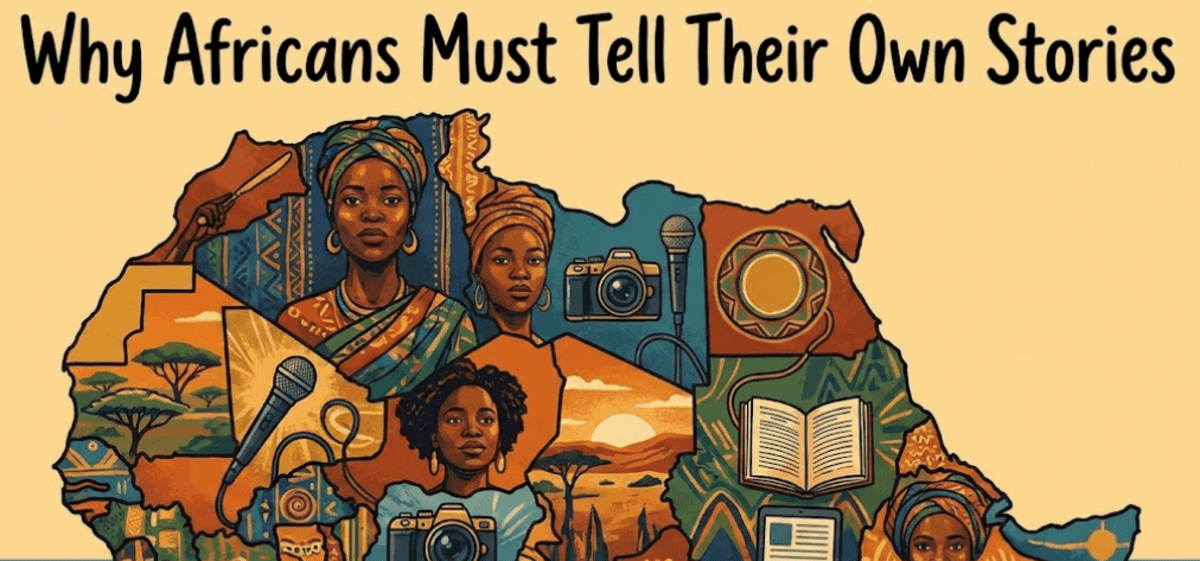
Africa has been spoken about for as long as I can remember. Spoken about in classrooms I never sat in. In documentaries narrated by voices that never sounded like mine. In charity campaigns, research papers, and headlines written far away from where the stories actually live. Africa is rarely silent. But too often, our voices are missing from the center of the conversation. I grew up encountering Africa as an explanation before I encountered it as an experience worth listening to. By the time I was old enough to question the world, Africa had already been summarized — what we lack, where we fall short, why we struggle. The story felt complete. Yet it was never whole. That is why African stories must be told by Africans.
Table of Contents
The Problem With Stories Told From the Outside
When people tell your story for too long, they begin to decide what matters about you. They choose which details are important and which are irrelevant. Over time, those selections harden into conclusions.
Africa, in many global narratives, has been reduced to a pattern:
- Poverty instead of context
- Conflict instead of history
- Need instead of capability
These are not lies — but they are not the truth either. They are fragments presented as the full picture.
Stories told from the outside often lack proximity. They observe without inhabiting. They describe outcomes without understanding causes. They measure without living inside the conditions being measured.
And without context, even well-meaning stories become distortions.
Growing Up African: The Context Headlines Never Carry
Growing up African means learning responsibility early. It means understanding family before understanding self. It means realizing, very quickly, that life does not pause for preparation.
Survival is not a dramatic event — it is routine.
Joy exists beside struggle, not as an escape from it, but as proof that life continues anyway. Laughter exists even when resources are thin. Community exists even when systems fail.
These are the everyday realities missing from many African stories told to the world.
No headline explains what it means to carry the expectations of an entire household before adulthood. No statistic measures the intelligence built by improvisation. No documentary captures the quiet dignity of people who endure without applause.
This context is not minor.
It changes everything.
What Happens When You Don’t Control Your Narrative
When a people do not control their narrative, something subtle happens. Over time, they begin to internalize other people’s conclusions.
Young Africans start to feel behind before they even begin. Success becomes something that must look foreign to feel valid. Worth is measured by distance — how far one has moved from home, culture, or accent.
This is not because Africans lack confidence.
It is because confidence erodes when you constantly see yourself described as incomplete.
The danger is not that the world misunderstands Africa.
The danger is that Africans start believing the misunderstanding.
Africa Did Not Lose Storytelling — It Lost Ownership
Storytelling is not new to Africa. It never was.
Before books, Africa told stories. Before archives, Africa remembered. History lived in proverbs, songs, elders, and moonlight conversations. Stories were not entertainment — they were education, identity, and survival.
Oral tradition shaped values long before formal institutions existed. Stories taught courage, restraint, community, and responsibility.
Africa did not forget how to tell stories.
Africa lost control over where its stories were told.
And when storytelling is removed from the people who live it, meaning is the first casualty.
Telling African Stories Is Not About Pride — It Is About Truth
Telling our own stories is not about pretending everything is fine. It is not about hiding pain or romanticizing struggle. It is not propaganda.
It is about balance.
It is about telling African stories in full — with failure and growth, pain and wisdom, confusion and clarity. It is about allowing Africa to be complex, human, and contradictory, just like every other place in the world.
A story told by the person who lived it carries a kind of authority that cannot be outsourced.
When Africans Tell Stories, the World Listens Differently
When Africans speak for themselves, something shifts. The tone changes. The listening changes.
Africa stops being a project and starts being a people.
The world listens with understanding instead of pity. With respect instead of charity. Stories move from “what is wrong” to “what is real.”
This is why platforms dedicated to authentic African stories matter. Ordinary Africans are not ordinary lives. They are witnesses to history unfolding quietly — in homes, markets, classrooms, farms, and cities.
These stories may never trend globally, but they shape generations.
Why Motivation.Africa Exists
Motivation.Africa exists because Africa deserves to be remembered correctly.
Not as a brand.
Not as a problem.
Not as a single story.
But as millions of lived experiences — told by the people who carried them.
This platform is not here to explain Africa.
It is here to let Africa speak.
If We Do Not Tell Our Stories, Someone Else Will
If Africans do not tell their own stories, others will continue to tell them on our behalf. And those stories, however well intentioned, will always be incomplete.
Africa does not need a louder voice.
Africa needs its own voice.
And it begins with telling our stories — clearly, honestly, and without permission.
Editor’s Note
As part of our renewed editorial focus, Motivation.Africa has returned fully to its original mission of documenting authentic African stories and lived experiences.
Our forex, trading, and market-related content has been migrated to our dedicated platform, myforexpips.com, where it will continue to be maintained and expanded.
Earlier forex-related articles published on Motivation.Africa will remain on this site as part of our publishing history, but all future trading content will live exclusively on myforexpips.com.