


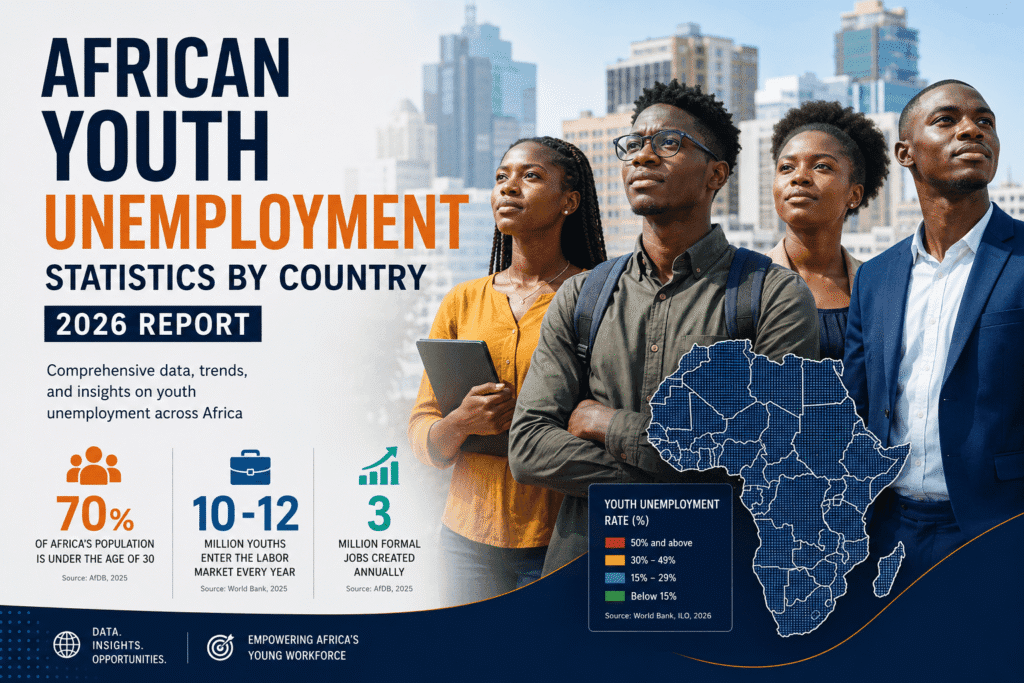
Africa is experiencing one of the largest demographic shifts in modern history. By 2050, the continent’s working-age population is expected to increase by more than 620 million people, accounting for over three-quarters of global labor-force growth in emerging economies. Yet despite this enormous human capital potential, youth unemployment remains one of the continent’s biggest economic and social challenges.
Millions of young Africans are unemployed, underemployed, or trapped in low-income informal jobs without stability or social protection. In countries like South Africa, Namibia, and Tunisia, youth unemployment rates remain among the highest in the world, while even countries with lower official unemployment rates still struggle with widespread vulnerable employment.
This 2026 African Youth Unemployment Statistics report examines:
- African youth unemployment statistics by country
- regional labor-market trends
- graduate unemployment
- NEET data (Not in Employment, Education, or Training)
- gender disparities
- economic causes
- future employment projections
The report uses data from:
- World Bank
- International Labour Organization (ILO)
- African Development Bank (AfDB)
- Mastercard Foundation
- national statistical agencies
Table of Contents
Key African Youth Unemployment Statistics (2026)
Here are some of the most important youth employment statistics in Africa:
- Africa adds roughly 10–12 million young people into the labor market every year.
- Only about 3 million formal jobs are created annually across the continent.
- Africa’s youth unemployment rate remains significantly higher than adult unemployment.
- In some African countries, youth unemployment exceeds 50%.
- Millions of young Africans work in the informal economy without stable income or social protection.
- Services and digital industries are expected to become major job creators by 2035.
According to the Mastercard Foundation’s Africa Youth Employment Outlook 2026, about 304 million African youths were employed as of 2025, but most work in informal, low-income sectors. The World Bank also notes that youth unemployment remains one of Africa’s biggest development challenges.
Why Official Unemployment Data Can Be Misleading in Africa
One of the biggest misconceptions about African labor markets is assuming low unemployment automatically means strong economies.
In many African countries:
- millions survive through subsistence farming
- informal street trading dominates
- youths work without contracts or benefits
- underemployment is widespread
This means official unemployment statistics often underestimate economic hardship.
For example:
- Tanzania’s official youth unemployment rate is reported at roughly 3%–4%
- Niger also reports low official unemployment
However, many young people in these countries work in:
- low-productivity informal sectors
- survival-based self-employment
Economists therefore increasingly focus on:
- vulnerable employment
- NEET rates
- income quality
- productivity
- underemployment
instead of unemployment alone.
African Youth Unemployment Statistics by Country (2026)
Below is a comparative overview of estimated youth unemployment rates across major African countries based on World Bank modeled ILO estimates and national labor-force surveys.
| Country | Estimated Youth Unemployment Rate | Economic Context |
|---|---|---|
| South Africa | 55%–60% | Severe structural unemployment |
| Namibia | 40%+ | Weak industrial diversification |
| Eswatini | 45%+ | Small labor market |
| Tunisia | 35%+ | Graduate unemployment crisis |
| Morocco | 22%+ | Urban youth joblessness |
| Egypt | 20%+ | Public-sector dependence |
| Nigeria | 12%–18% officially | Large informal economy |
| Kenya | 13%–16% | Skills mismatch |
| Ghana | 12%+ | Rising graduate unemployment |
| Algeria | 25%+ | Youth-heavy labor pressure |
| Ethiopia | Below 10% officially | Underemployment remains high |
| Rwanda | Below 10% officially | Informal employment dominance |
| Tanzania | Around 3%–4% officially | High informal labor participation |
| Niger | Very low official unemployment | Subsistence agriculture economy |
Source: World Bank, ILOSTAT, national labor agencies.
Why South Africa Has the Highest Youth Unemployment Rate in Africa
South Africa remains the country with the highest youth unemployment rate in Africa and one of the highest globally. According to labor-force surveys and Reuters economic reporting:
- South Africa’s official unemployment rate exceeded 32% in 2025
- expanded unemployment reached over 43%
- youth unemployment among ages 15–24 often exceeds 55%
Several structural issues contribute to this crisis:
- legacy inequality from apartheid
- weak manufacturing growth
- poor labor-market absorption
- low private-sector hiring
- educational inequality
- slow GDP growth
South Africa’s unemployment problem has become a major political and economic issue because prolonged youth unemployment often contributes to:
- rising crime
- protests (e.g., xenophobia)
- migration pressure
- social instability
Nigeria’s Youth Employment Challenge
Nigeria has Africa’s largest population and one of the continent’s youngest labor forces.
Despite rapid growth in:
- fintech
- digital entrepreneurship
- entertainment
- e-commerce
Many Nigerian youths still struggle to secure stable employment.
The country faces multiple labor-market problems:
- weak industrialization
- unreliable power infrastructure
- limited manufacturing
- graduate oversupply
- informal labor dominance
According to World Bank modeled estimates, Nigeria’s youth unemployment rate remains relatively moderate compared to South Africa, but underemployment and vulnerable work remain extremely high.
Many Nigerian youths increasingly turn to:
- remote work
- freelancing
- content creation
- online businesses
- forex trading
- gig platforms
as alternatives to traditional employment.
Countries With the Lowest Youth Unemployment in Africa
Some African countries report relatively low youth unemployment rates.
These include:
- Niger
- Chad
- Rwanda
- Burundi
- Ethiopia
However, low unemployment rates do not always mean strong economies.
In many cases:
- young people work in subsistence agriculture
- informal jobs dominate
- wages are extremely low
- productivity remains weak
This means many African youths are technically “employed” but still living in poverty. The Mastercard Foundation notes that informal employment dominates youth labor markets across Africa.
Youth Unemployment by African Region
Southern Africa
Southern Africa has the highest youth unemployment levels on the continent.
Countries like:
- South Africa
- Namibia
- Eswatini
continue to struggle with slow industrial growth and economic inequality.
North Africa
North African countries face strong graduate unemployment pressures.
Countries such as:
- Tunisia
- Algeria
- Morocco
- Egypt
produce large numbers of graduates annually, but cannot absorb them into high-skilled employment.
This creates:
- migration pressure toward Europe
- frustration among educated youths
- political instability risks
West Africa
West Africa experiences rapid population growth combined with limited formal-sector employment.
Nigeria and Ghana continue to face:
- underemployment
- migration pressure
- youth entrepreneurship challenges
East Africa
East African countries generally report lower official unemployment rates.
However:
- informal work remains dominant
- many young workers earn very low incomes
- rural employment still accounts for a large share of jobs
Graduate Unemployment in Africa
One of the biggest labor-market problems in Africa today is graduate unemployment. Thousands of graduates complete university education every year but struggle to find jobs aligned with their degrees.
Major causes include:
- outdated educational systems
- weak technical training
- low industrialization
- lack of digital skills
- poor university-industry collaboration
Countries heavily affected include:
- South Africa
- Nigeria
- Tunisia
- Ghana
- Kenya
This has contributed to:
- migration
- brain drain
- rising interest in remote work
- startup culture growth
NEET Statistics in Africa
NEET refers to young people: Not in Employment, Education, or Training. This metric is increasingly important because it measures hidden youth exclusion beyond official unemployment figures.
Many African youths are:
- not studying
- not working
- not receiving skills training
This creates long-term risks for:
- economic productivity
- political stability
- social development
The ILO and World Bank continue to warn about the rise of vulnerable youth populations across parts of Africa.
Major Causes of Youth Unemployment in Africa
1. Rapid Population Growth
Africa’s youth population is growing faster than job creation. Millions enter the labor market yearly while formal jobs remain limited.
2. Weak Industrialization
Many African economies depend heavily on:
- raw materials
- agriculture
- imports
instead of large-scale manufacturing and industrial production.
3. Skills Mismatch
Employers increasingly demand:
- digital skills
- technical expertise
- AI literacy
- vocational training
Many educational systems are not adapting quickly enough.
4. Political Instability
Conflict and insecurity continue to disrupt labor markets in parts of:
- Sudan
- Sahel region
- Democratic Republic of Congo
5. Informal Economy Dominance
A large percentage of African youths work without:
- contracts
- job security
- social protection
- healthcare benefits
Informal Employment: Africa’s Real Labor Market
One of the most important realities often ignored in unemployment discussions is that Africa’s labor market is dominated by informality.
According to development reports:
- over 80% of jobs in some African economies are informal
- millions work without contracts or social protection
- income instability remains extremely high
Informal workers often lack:
- healthcare benefits
- pensions
- job security
- legal protections
This is why many economists argue Africa’s biggest employment challenge is not only unemployment — but poor-quality employment.
The Rise of Digital Jobs and Remote Work in Africa
Despite the challenges, Africa’s digital economy is creating new opportunities.
Growing sectors include:
- software development
- content creation
- remote customer support
- AI services
- fintech
- e-commerce
- online education
According to recent labor projections, Africa’s services sector may soon overtake agriculture as the largest youth employer. Countries investing heavily in digital infrastructure may experience faster youth employment growth in the coming decade.
Government and International Responses
Several organizations are investing heavily in youth employment initiatives across Africa.
These include:
- African Development Bank
- International Labour Organization
- Mastercard Foundation
- World Bank
- national youth empowerment programs
Major focus areas include:
- entrepreneurship funding
- vocational training
- startup ecosystems
- digital literacy
- women empowerment
- SME financing
Governments are also expanding:
- innovation hubs
- tech incubators
- youth grants
- skills acquisition programs
Future Outlook for African Youth Employment
Africa’s employment future will largely depend on:
- economic diversification
- technology adoption
- education reform
- industrial growth
- entrepreneurship support
While unemployment remains a serious challenge, Africa’s young population also represents one of the world’s greatest economic opportunities.
If governments and private-sector stakeholders invest effectively in:
- digital transformation
- skills development
- infrastructure
- innovation
Africa could become one of the largest labor-force growth centers globally by 2040.
Final Thoughts
African youth unemployment remains one of the defining economic issues of this generation. While some countries continue to face extremely high unemployment rates, the broader reality is even more complex because millions of youths remain trapped in informal and vulnerable work.
Still, opportunities are emerging through:
- technology
- entrepreneurship
- remote work
- digital services
- innovation ecosystems
The countries that successfully invest in education, industrialization, and youth empowerment may unlock Africa’s enormous demographic potential in the decades ahead.
Data Sources
- World Bank Youth Unemployment Data: World Bank Data Portal
- ILOSTAT Africa Labour Statistics: ILOSTAT Africa Data
- African Development Bank Youth Employment: AfDB Youth Employment Programs
- Mastercard Foundation Africa Youth Employment Outlook 2026: Mastercard Foundation Report
- ILO World Employment Outlook: ILO Employment Trends Report