


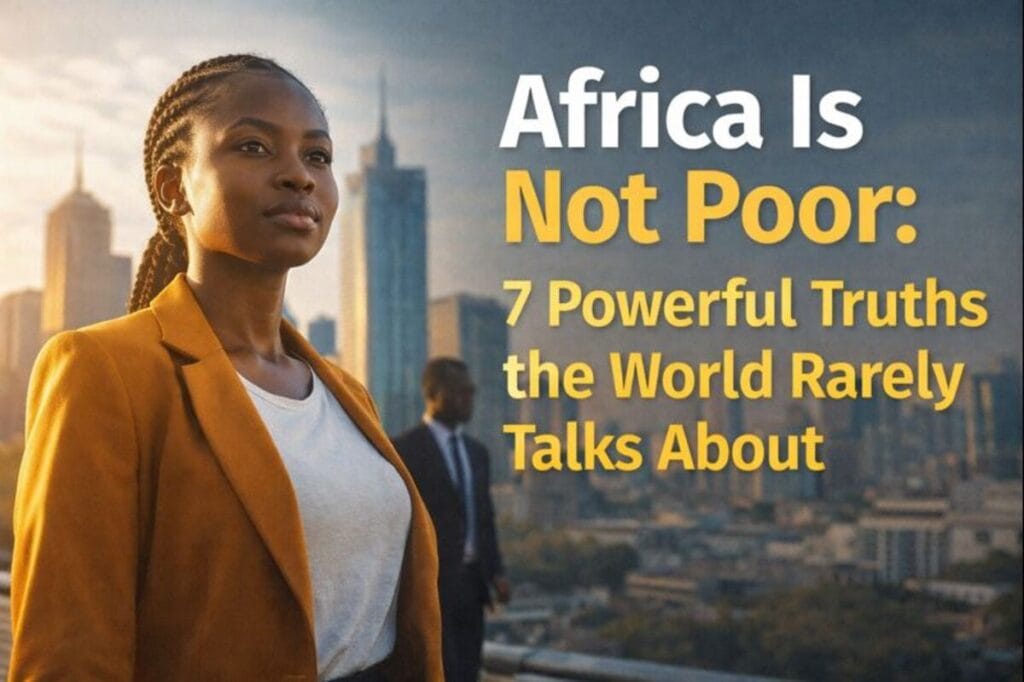
For decades, Africa has been reduced to a single, damaging narrative: poverty. But behind the headlines is a continent rich in resources, talent, and momentum—one the world rarely talks about honestly. Over time, this has shaped how the world views Africa—and, more dangerously, how Africans sometimes view themselves.mBut this story is incomplete, outdated, and deeply misleading. Africa is not poor.
What exists is a continent rich in resources, talent, culture, ideas, and opportunity—often misunderstood, oversimplified, or intentionally underreported. Poverty exists in Africa, just as it does in every region of the world, but it is not Africa’s defining feature.
Learn the Secret of Forex Trading, Click here to download a free e-book now
To understand the continent honestly, we must look beyond the headlines. Here are seven powerful facts about Africa that the media rarely talks about.
Table of Contents
1. Africa Is One of the Richest Continents in Natural Resources
Africa is extraordinarily wealthy in natural resources—by global standards.
The continent holds:
- About 30% of the world’s mineral reserves
- Over 40% of global gold deposits
- Around 70–90% of the world’s cobalt, a critical resource for electric vehicles, smartphones, and renewable energy storage
- Vast reserves of oil, natural gas, diamonds, lithium, uranium, and rare earth minerals
The Democratic Republic of Congo alone plays a central role in the global green energy transition because of its cobalt supply. Nigeria, Angola, and Libya remain major oil producers. Southern Africa holds enormous mineral wealth, while West Africa is rich in gold and agricultural resources.
The issue has never been a lack of wealth. The real problem is ownership, management, and value extraction.
Many African countries export raw materials at low prices and import finished products at a premium, locking them into an unequal global trade system. Wealth leaves the continent before it can be fully transformed into jobs, infrastructure, and long-term prosperity.
2. Africa Is Home to the World’s Youngest and Fastest-Growing Workforce
Africa is the youngest continent on Earth. More than 60% of Africa’s population is under the age of 25, and by 2050, Africa is expected to have the largest working-age population in the world, surpassing both China and India.
This is often framed as a problem. In reality, it is one of Africa’s greatest advantages.
Youth represents:
- Energy and adaptability
- Innovation and creativity
- A rapidly growing consumer market
- A future workforce in a world facing labor shortages
While Europe, Japan, and parts of Asia struggle with aging populations and shrinking labor forces, Africa is entering its demographic prime. The key challenge is not numbers—it is education, skills development, job creation, and leadership.
If harnessed properly, Africa’s youth population could fuel decades of economic expansion.
3. Several African Economies Are Growing Faster Than the Global Average
The idea that Africa is economically stagnant does not match reality. In recent years, several African countries have consistently recorded growth rates higher than the global average, often outperforming developed economies.
Countries such as Rwanda, Senegal, Côte d’Ivoire, Ethiopia, Benin, and Ghana have seen strong growth driven by:
- Infrastructure development
- Technology adoption
- Manufacturing and services
- Regional trade and integration
While economic growth is uneven across the continent, it is inaccurate to describe Africa as a place where nothing works. Progress may be quieter than crisis, but it is real—and accelerating in many regions.
4. Africa Is Not Aid-Dependent—It’s Resource-Leaking
One of the most persistent myths is that Africa survives on aid. The reality is more uncomfortable.
Africa loses more money than it receives.
Through:
- Illicit financial flows
- Tax evasion by multinational corporations
- Debt servicing
- Unfair trade arrangements
Africa loses tens of billions of dollars every year, far exceeding the amount it receives in foreign aid. Foreign aid often dominates the narrative, but it represents only a fraction of the wealth that leaves the continent annually. This is not poverty—it is systemic economic leakage.
When African countries are able to retain more value locally, invest in infrastructure, and strengthen institutions, growth follows quickly.
5. African Entrepreneurs Are Solving Real Problems at Scale
Across the continent, African entrepreneurs are building practical, scalable solutions to everyday challenges. From fintech to agriculture, health care to logistics, Africans are innovating for their own realities.
Examples include:
- Mobile money platforms used by tens of millions of people
- Agritech startups improving yields and food security
- Health-tech platforms expanding access to medical care
- Renewable energy solutions bringing power to off-grid communities
These are not charity projects. They are businesses—many of them profitable and attracting global investment. African innovation is increasingly shaping how emerging markets solve problems efficiently and affordably.
6. Africa Is Rich in Culture, Knowledge, and Human Capital
Wealth is not measured only in GDP.
Africa is rich in:
- Thousands of languages and cultures
- Deep indigenous knowledge systems
- World-class artists, writers, scientists, athletes, and thinkers
- A growing global diaspora influencing business, technology, and culture
African music, fashion, literature, and film now shape global trends. African professionals lead companies, research institutions, and movements around the world.
This cultural and intellectual capital has economic value—and Africa has it in abundance.
7. The “Africa Is Poor” Narrative Is a Business Model
Poverty sells. Crisis attracts attention. Simplified stories are easier to tell than complex realities.
Many global narratives:
- Ignore African success stories
- Overgeneralize 54 countries into a single image
- Focus on failure while overlooking progress
This framing affects investment decisions, policy priorities, and self-perception. When Africa is constantly portrayed as poor, it becomes easier to justify exploitation, neglect, and unequal partnerships.
Changing the narrative is not about denial. It is about accuracy, balance, and fairness.
The Real Story: Africa Is Rising, Not Begging
Africa’s challenges are real:
- Leadership gaps
- Governance weaknesses
- Conflict in some regions
- Foreign interference
But these challenges do not define the continent.
Africa is not poor.
Africa is underestimated.
Africa is misrepresented.
Africa is awakening.
The future will not ask whether Africa can rise.
It will ask who was paying attention early enough.